In late 1967, with New College having serious fiscal problems, a decision was apparently made to recruit lower-achieving students for the next incoming class (1968), with the implicit assumption that such students would not be as generously supported as most of us in the early classes.
Brud Arthur, in his history of New College, writes about the early efforts to recruit the charter classes:
At [Dean of Admissions] Norwine’s insistence, [President] Baughman told the trustees that New College must have a liberal scholarship program. He emphasized that the college “must go out and buy students,” a term Norwine himself disavowed. Certainly, liberal scholarships would be needed to attract good students, the high school valedictorians and salutatorians who would add luster to the charter class.
New College: The First Three Decades
Early budgeting had mistakenly assumed that student tuition fees would make a significant contribution to college finances. This mistake was not the only reason for the school’s financial problems (overoptimism about fundraising was probably the biggest one), but these were desperate times, and tuition fees could help.
In late 1967, a brochure was created to encourage lower-performing high-school students (and their guidance counselors) to apply for the next incoming class. Copies of the brochure were leaked before it was mailed; you can read it for yourself:
One could never be certain what would arouse students. … Another time, offended by the tone of a brochure being sent out by the admissions office, students confiscated the mailing. Norwine capitulated and had the piece destroyed.
It’s doubtful that the tuition income would have made a significant dent in the funding shortfall. In the event, we went from financial crisis to crisis until finally being absorbed into USF in 1975, only narrowly averting bankruptcy.
This is not the first time that New College students were housed in hotels because the Pei dorms were not habitable.
Yesterday (17 August 2023), New College issued a press release. In part:
COLLEGE ANNOUNCES HOTEL PARTNERSHIPS FOR NEW AND RETURNING STUDENTS THIS FALL
SARASOTA, Fla. New College of Florida is excited to announce …
Out of an abundance of caution, and for the health and safety of the NCF community, Interim President Corcoran has made the decision to shutter all of the Pei dorms. This decision was made after the recent engineering report indicated air quality concerns.
… NCF will occupy the entirety of the Home2Suites location just north of campus and a large block of rooms in the adjacent Hilton Garden Inn. Upperclassmen will be housed in the Hyatt Regency in vibrant downtown Sarasota.
When the first entering class arrived at New College in the fall of 1964, the Pei dorms were still under construction, well behind the original schedule. The owner of the Landmark Hotel on Lido Key, a New College trustee, offered to accommodate the class at his hotel, and the school obtained a Navy-surplus bus to transport the students between the hotel and campus.
The dorms were still under construction at the end of the first term, when the hotel had committed to winter tourists, and after considering alternatives, the boys were housed in the (unheated) Barn (now a coffee shop), and the girls in the “temporary” building that would house the natural sciences division. The same source that had supplied the surplus bus also came up with surplus cots and other furnishings for the temporary quarters.
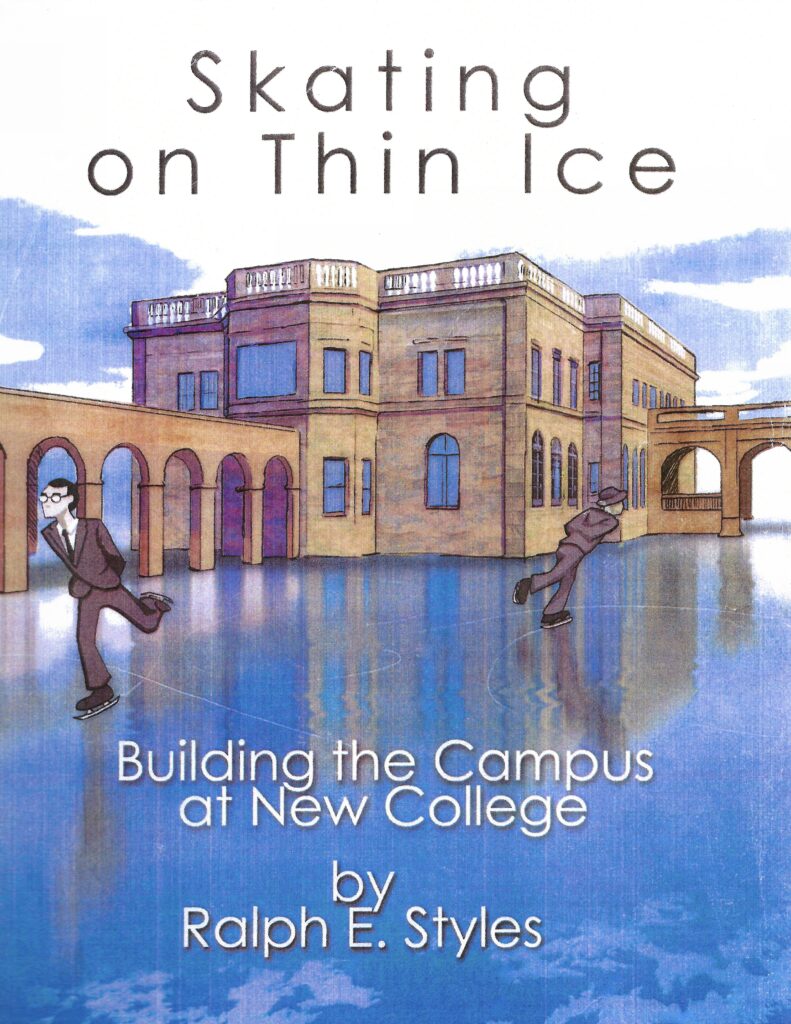
By late March 1965, students began moving into the new Pei dorms, as rooms became finished and available. The Pei dorms would be sufficient to house all resident students until the entering class of 1969, when the West (Palmer) Campus dorms were opened. (See Capt. Ralph Styles’ book “Skating on Thin Ice” for a more detailed account of this story, and much more.)
Both in 1964 and 2023, students were housed in local hotels because the Pei dorms were not habitable. When New College first opened, the Pei dorms were not yet habitable; as the college that we knew comes to a close, they are no longer habitable.
The Pei dormitories housed New College students for 58 years and a few months. They and their Palm Court were both iconic and problematic from the beginning, beautiful to look at, distinctive to live in, and expensive—too expensive—to maintain. Decades of deferred maintenance can no longer be ignored.
I doubt that the Pei dorms will ever be occupied again, but rather will be allowed to continue to deteriorate, without intervention, until there is no choice but to demolish them “out of an abundance of caution”.
In the meantime, their walls bear witness to 59 years of our loves and traumas, tribulations and celebrations. We will still have our stories and our memories.
John W Gustad was appointed academic dean (later provost) of the nascent New College in mid-1963. In the spring of 1964, he participated in a colloquium, sponsored by Florida State University, on experimental colleges. This paper is part of a collection that grew out of that colloquium.
Those of us who were recruited in those early years (the first class entered in September 1964; I arrived in September 1966) will recognize the pitch.
Back in the spring of 2016, Nimb.e (“The e-magazine of New College of Florida”) published Professor David Rohrbacher’s account of how the official New College seal came to be corrected. Since the article (and indeed Nimb.e) has disappeared from the web, I’m making it available again here for those who are interested in the full story.
Update: The Catalyst has published “History of the Four Winds seal” by Maya Rish, recounting the history of the seal as (extensively) researched by art history professor Malena Carrasco.
The Secret of the Seal
Professional Latinist sets right a decades-old mistake by David Rohrbacher, Associate Professor of Classics, Humanities
When an alum happens upon the distinctive image of the New College seal, with the four winds symbol, the central sun, and the College’s name and founding date in Latin, I expect it provokes a number of positive emotions — a warm nostalgia for friends and teachers, a joyful celebration of the distinctive mission and atmosphere of New College, a sense of pride for the accomplishments involved in earning a degree.
While I am not immune from those emotions, as a professor of Classics since 2000, and the primary teacher of Latin at New College since that time, they have been mixed with embarrassment, and even pain.
You see, the Latin of the seal of New College of Florida, “Novum Collegium Floridae”, is ungrammatical.
OK, here’s the Latin part. You can skip ahead if you don’t want to think about grammar too much. The ending “ae” on the word Floridae represents a way that Latin expresses the preposition “of”. But “of” can have a variety of meanings — compare the use of “of” in “a friend of the family”, “a piece of pizza”, and “hatred of war”, which in Latin are called possessive, partitive, and objective, respectively. But Latin wouldn’t use the “ae” ending to translate “of” in the phrase “New College of Florida”, which doesn’t fit into any of the above categories. Instead, Latin would properly use an adjectival form of the noun, saying, literally, “Floridian New College”, “Novum Collegium Floridense”. (Compare the language on the seal of New College, Oxford: “Novum Collegium Oxoniense”.)
The Old and the New
My predecessors in classics at New College, John Moore and Lyndon Clough, were widely respected for their brilliance. It seemed impossible that they could be responsible for this error. Working with librarians Sarah Norris and Ana McGrath ’09, I found the answer in the digital repository, an online collection of documents and publications relating to New College and accessible to researchers around the world. The architectural firm of I.M. Pei, who designed the seal, put a lot of effort into exploring and explaining the symbolism of the winds and sun, but, apparently, shockingly little effort into correctly translating the name of the college into Latin.
An ungrammatical seal
I kept this shameful secret mostly to myself until last fall, when President Don O’Shea asked me to form a committee to explore possible changes to the language of the New College diploma. I seized the opportunity to expand the reach of the committee, which was dubbed the “ad hoc committee on the New College diploma and seal”, and included among its mandates the mission to “raise consciousness about the ungrammatical nature of the New College seal”. Nine faculty members, a librarian, and four students comprised this committee. Classics professor Carl Shaw initiated the consciousness-raising process through his introduction of the committee’s mascot, “ungrammatical seal”, pictured here.
As a next step, I proceeded to raise the consciousness of Jessica Rood, director of communications, who recognized that the tone of academic tradition and excellence provided by the use of Latin in the seal was potentially undermined by its ungrammatical nature. She coordinated with the New College Alumnae/i Association and the office of the president to explore what this change would entail, and designed a beautiful seal with retains the balanced form of the original while having the additional merit of being grammatical.
In an emotional PowerPoint presentation at a faculty meeting in March, I made the case for officially changing the seal to the new language, “Novum Collegium Floridense”. The motion found strong faculty support and the new seal will be gradually introduced as opportunities arise. Save your belongings emblazoned with the old seal! Soon they will be valuable collector’s items!
There have been dark times in recent years that I have even wished that I had never learned Latin, to spare myself the pain of seeing our ungrammatical seal. But being at New College has taught me the importance of facing problems head on, and this success has left me hopeful about the future. After all, it only took 40 years, a committee of 14 people, and careful coordination between several administrative units at the College to accomplish this minor grammatical change.
With a similar, societywide effort, perhaps we could all work together to do something about the confusion between “its” and “it’s”, or people using the word “impactful”.
And listen, if you or someone you love is considering a tattoo in Latin — please, send me an email first so I can check your grammar. Even a faculty committee can’t do anything about an ungrammatical tattoo.
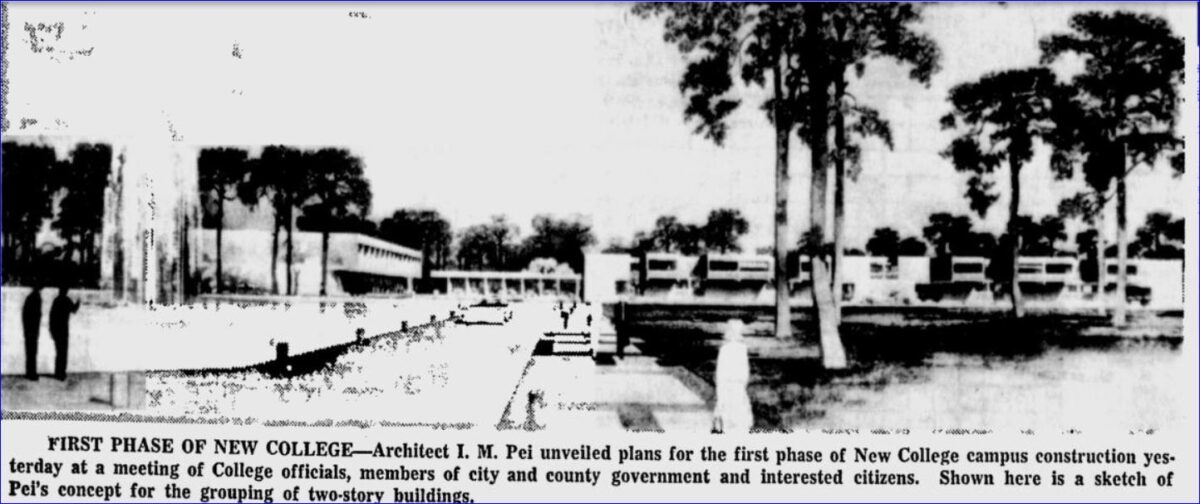
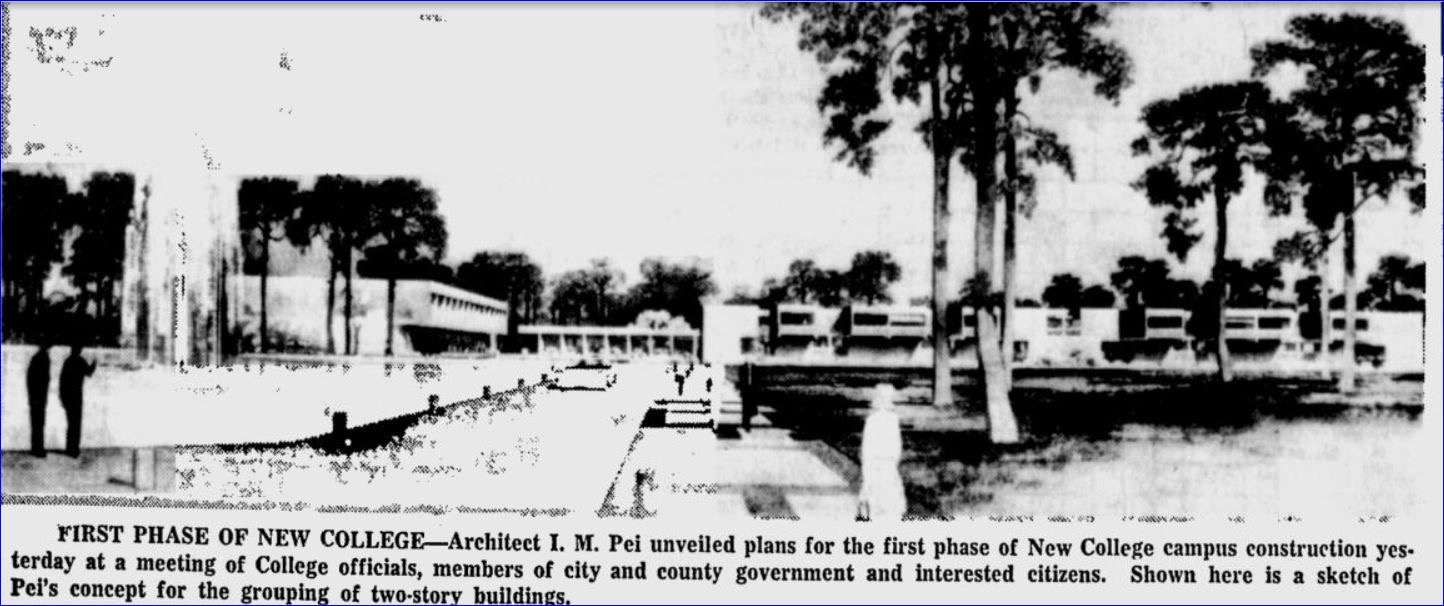
In 2005, [US Navy submarine] Captain Ralph Styles turned 95 and decided to write a memoir documenting his time at New College from 1963 to 1970 as “director of planning, management of all real estate, construction, liaison with architect [I M Pei] and supervisor of building and grounds”. The memoir was never formally published, but exists in the form of a few copies run off for friends and the College. Through the volunteer efforts of alums, we now have an electronic (PDF) copy of “Skating on Thin Ice”.
The Captain’s point of view gave him a unique perspective on the early years (the first class would’t arrive until the fall of 1964) of the college, most notably his direct involvement with land acquisition (and disposal), construction and remodeling and his interactions with Pei. Objective history aside (and there’s a set of appendices documenting much of his story), Styles makes clear, sometimes subtly, sometimes not so much, his views on many of the early players (in one vignette, Doug Berggren plays prima donna, insisting on an office with a window as Styles is overseeing the creation of faculty offices in the newly remodeled College Hall).
Read it. It won’t take long, and it’s free (as in beer).
Some time back (OK, it’s been a while) I documented a method for ripping audiobook CDs with iTunes and “reading” them via a Smart Playlist. Times have changed; not only is there no more iTunes, but the native audiobook player is now in Books. Time for an update.
Rip the CDs
Insert the first CD into your reader. Music will open it and look up its metadata. Most audiobooks have metadata available, and some have more than one version. Choose the most likely-looking one if there’s more than one. We’ll clean it up later. Do ensure that each ripped CD has its disk number somewhere in its metadata (add it if necessary), so that the disk order remains clear. Library CDs are prone to mishandling, and sometimes don’t get read correctly. If that happens, try washing them. Warm water, a little dish detergent, rinse well, dry well, and try again
Select all the tracks, and use the gear menu (above right) to Join CD Tracks. (This was broken/unavailable in macOS Monterey until v12.3, when it was fixed.)
Click the Import CD button (next to the gear). You’ll be offered a choice of import settings. I generally settle for AAC/Spoken Podcast, though MP3 is fine, and I might choose higher quality for a fully produced audiobook (with music and sound effects, say). Click OK, wait for the CD to be imported, and click the eject button.
Repeat steps 1–3 for the remaining CDs.
Fix up metadata
If you view your library as Songs and sort by Date Added, you should find all your disks grouped at the top of the list. Select them all and enter (as necessary) the album (book title), artist (author), genre (I use Audiobook here; suit yourself), total disk count, and anything else that’s common to all the disks.
One disk at a time, set each Song field to indicate which disk it is; these will become something like chapter names. For example, I just ripped Circe, which goes in the Album field, and put “Circe 1″, Circe 2” etc in the Song fields. Using either the track or disk-number fields, number the disks, and clear the fields you’re not using. I do mine as track numbers, and clear the disk numbers.
Select all the disks again, and in the Artwork tab drag in a suitable image. You can usually find something appropriate online, often the cover image of the commercial CDs themselves. While you’re at it, in the Options tab, check both “Remember playback position” and “Skip when shuffling”. These aren’t actually used by audiobook readers, but if you leave the book in Music, you’ll want these checked.
Finally, make sure that Music is recognizing all the tracks as belonging to a single album (assuming you’ve used track numbers for your sequencing). If it doesn’t, double-check that all the metadata (except for Song and Track number) is identical for all disks. (I’ve noticed that Music can be confused about this. If everything checks out and Music still sees more than one album, don’t worry about it.
Copy to Books
Select one of the disks, right- or control-click it, and select Show in Finder. You should see all your disks in a single folder whose name is the book’s title (which in turn is in an author folder). If this is not what you see, go back to Step 8 and check your metadata.
Select all the book’s files in the Finder and drag them to the Books icon in your Dock (launch Books if necessary to force it to appear). (Alternatively, you could add these files to another audiobook reader, using its instructions for doing so. I’ve used the Bookmobile on my iPhone in the past, though these days I mostly use Books.)
Assuming you’re set to to sync Books across your devices, you should eventually find the new book on your iPhone (or iPad) in Books. If you’re not using iCloud sync, you can directly your device to your Mac via cable or Wi-Fi (you might need to enable audiobook sync first).
As iTunes has evolved, it’s gotten easier to import audiobook CDs for later listening on your iPhone. It’s especially handy for library audiobooks, freeing one from the overhang of a due date. This is a guide to one way of doing it that’s worked well for me over the years. It’s written for iTunes 12.
There are three tasks: rip the CDs, put them in a smart playlist, and fix up the metadata. We’ll go over each one. My example is Ann Patchett’s State of Wonder, on 11 CDs.
Rip the CDs
Pro tip: library CDs tend to be mishandled, and sometimes don’t get read correctly. If that happens, try washing them. Warm water, a little dish detergent, rinse well, dry well, and try again.
1. Insert the first CD into your reader. iTunes will open it look up its metadata. Most audiobooks have metadata available, and some have more than one version. Choose the most likely-looking one if there’s more than one. We’ll clean it up later.
2. Select all the tracks, and choose the “Join CD Tracks” item from the Options menu, top right of the window. If you don’t see that item, try clicking the top of the leftmost column, the one with the track numbers in it, such that the tracks are ordered from 1 on.
3. Click the Import CD button, top right. You’ll need to choose Import Settings; I generally use the AAC encoder, and Spoken Podcast. Up to you…
4. Repeat steps 1–3 for the remaining CDs.
Create playlist
5. Once the first CD is imported, create a new smart playlist (File > New > Smart Playlist), with Album set to the album name, and a second criterion of “Plays is 0”.
Fix up metadata
6. When the CDs are first imported, they’re classified as music, so they’ll show up in iTunes’ My Music section, in case you need to track down any that (perhaps because of a bad album name) didn’t show up in your playlist. If the audiobook had no beta-data available in step 1, you’ll need to give them all an album name (the name of the book) first. Once everything is there, the playlist is where will be working on metadata.
7. Edit each ripped CD using Get Info on an individual CD, or for metadata that’s the same for every CD (like the album name), selected them all and then Get Info.
8. Metadata fields that should be the same (and correct) for all CDs: album (title of book), artist (author), composer (reader), genre (I use ‘audiobook’), year, track x of y (empty), number of disks. Uncheck the compilation box if it’s not already unchecked. If iTunes won’t let you edit one of these fields, do it on a CD-by-CD basis instead.
9. Metadata fields that are different for each CD: song name (I’ll name these “State of Wonder 1” through “State of Wonder 11”), and disk number. Use the forward button in the Info window to move from CD to CD.
10. Artwork. If iTunes doesn’t find the right artwork for the book, try Google Images. It’s generally pretty good at finding a usable image.
Eric Von Schmidt played a concert at New College on 6 October 1967, three days after Woody Guthrie died. Eric promised “one for Woody”, and delivers here.
It’s been 47 years. Celebrate “with a wet belly and a dry eye!”
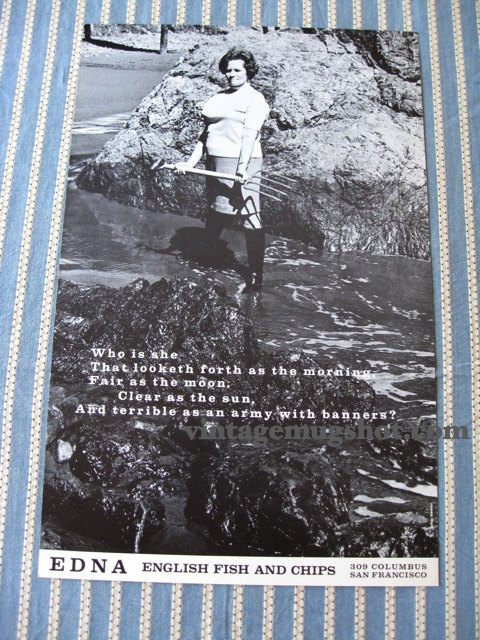
Who is she
that looketh forth as the morning,
fair as the moon, clear as the sun,
and terrible as an army with banners?
Edna ran a fish & chips shop on Columbus in North Beach in the 60s and early 70s. It was a work of culinary art, and she knew it. A narrow storefront, as I recall, and perhaps 2,3,4 stools. I miss it, Edna, her fish, her chips, her art. I ate there, from time to time, oblivious.
(Song of Solomon 6:10, to save you the trouble. KJV. (I’m not, particularly, a big KJV fan. But here they’ve got it right, and everyone else, not.))
The chimera of myth consisted of the parts of three animals: lion, serpent and goat. By extension, a bio/genetic chimera is an animal composed of more than one genetic line (Wikipedia is there to help if you want to know more).
Let’s consider chimerism in grammar. In English, we usually inflect words to indicate number (the chimera devours, the chimeras devour), tense (the chimera devours/devoured), comparative & superlative (chimeras are scary/scarier/scariest), &c.
Inflections can be regular (devour/devoured) or not (eat/ate). But some irregular inflections move beyond mere irregularity.
Example 1: bad/worse/worst. Badder & baddest, now non-standard, were once the comparative & superlative of bad. But some while back, “worse”, the comparative of what is now German wirren, confused, was called into service as the comparative of “bad”. Similarly (but harder to trace), good/better/best.
Example 2: go/went/gone. “Went” was (and I suppose still is) the past tense (or, as the cool kids say, preterite) of “wend”. But long time since it was pressed into service as the preterite of “go”.
Example 3: You might object that my first two (or three, I suppose) examples are, being only two-part hybrids, don’t truly qualify as chimeras. So I’ll leave you with “to be”, a true chimera, being, in the words of the OED, “a union of the surviving inflexions of three originally distinct and independent verbs”.
You can’t do better here than to go directly to the OED. I’ll whet your appetite with the very beginning of its article “be”:
Consider this an unsolicited endorsement: Fever Tree Ginger Beer is the best. Ya gotta like ginger, but why else would you be drinking it? It comes, somewhat idiosyncratically, in 200ml & 500ml bottles. Suits me; the 200ml is a nice hit.
Update. Fever Tree is fine, but Q is better; a little more ginger, less sugar, more aromatic. And at least based on a single sample, Sky Valley is better yet, but I haven’t found any more after that first bottle (Whole Foods, Minneapolis).
Michiko Kakutani, in her review of my book of essays “The Way the World Works,†says of me: “He even seems to suggest some sort of moral equivalence between the Nazis and the Allies.†I certainly don’t suggest that, and as I’ve repeatedly said in public, I totally reject the notion of moral equivalence as a way of looking at World War II.
Each murder, whether in war or peace, is a separate wrong: one of the things we have to do to get ourselves moving in the right direction — away from retribution, vengeance, payback — is to stop bundling deaths together and weighing them on a giant scale.
(You probably don’t care about this; move along…)
There’s some awfully specific rumor-mongering going on about a 7.85″ iPad (vs the current 9.7″ models). I’m all for it (an iPad Mini, that is), so why not join the rumorati?
I’m mildly skeptical of the 7.85″ number. The rationale appears to be that that’s what you get if you do a 1024×768 screen (same as iPad 1 & 2) with the pixel pitch of an iPhone 3GS. I suppose that 7.85″ is as good as any number in that range (though it seems just a tad large to me), but I don’t buy for a second the argument that there’s some major advantage to Apple in sticking with the legacy iPhone pixel pitch. The Mini will undoubtedly use much more modern screen technology, with a physical size driven by usability concerns.
The pixel pitch implied by 7.85″ (or implying 7.85″, as the case may be) is also, at 163, on the low side in a world of Retina displays. Another reason to shrink it a bit more, if we’re sticking with the same pixel count (seems very, very likely).
My guess: somewhat smaller than 7.85″, but at least a little different from Amazon’s and Google’s 7″ offerings. Let’s say 7.25-7.5″, OK?
4G/LTE vs 3G? Dunno. Don’t care. But let’s say so, for competitive reasons.
What I would like, though, is a telephone. Not because I have a lot of use for telephony, but rather because I don’t. I could see abandoning a phone entirely in favor of an iPad Mini with an Apple-design Bluetooth headset accessory, especially if it handled music well. Even with an iPhone and a wired headset I rarely hold the phone to my ear (hell, I rarely talk on the phone, period). And the ability to use Messages for SMS/MMS would be a nice side benefit.
Of course, this makes as much sense for a full-size iPad as a Mini. No problem; let’s do both.
And a new docking connector. Magnetic. Implying that we’re going to see at least a minor bump to the iPad 3 (new display technology too?), and, ho-hum, the iPhone 5.
(See, I told you not to read it. Don’t come crying to me.)
Afterthought: consider that a voice-capable iPad, Mini or no, needn’t be sold on the carrier-subsidized contract terms of an iPhone. Think of it as more like an unlocked iPhone, at unsubsidized iPad 3G prices. BYO SIM.
Reporters at NPR have the time to look up the requirements of the Affordable Care Act and calculate their impact on employers. Its listeners do not. For that reason, it is incredibly irresponsible to simply report the views of one small business owner saying the bill will be a big burden and then another who says it will guarantee him and his wife insurance.
Morning Edition could have taken 30 second to give listeners an idea of the size of the burden that the ACA imposes. For firms that employ fewer than 50 workers, there are no requirements. Firms of 50 workers or more must either provide insurance or pay a penalty.
The size of penalty is $2,000 per worker, with the first 30 workers exempted. This means that if a company employs exactly 50 workers (as could be the case with the employer profiled), then the company would have to pay a $40,000 fine. If the average pay for a worker is $10 an hour (in other words, everyone gets close to the minimum wage), this fine would add 4 percent to the company’s wage bill. If the employer currently pays for some care (as the employer profiled claimed he did), he would be able to stop paying for the care, which would offset much or all of this cost.
By comparison, past minimum wage increases have been on the order of 15-20 percent. Extensive research has found that these increases in labor costs have had little or no impact on employment, meaning that firms have been able to absorb this additional expense without substantially changing their operations. This research suggests that the burden imposed by the ACA would have relatively little impact on business.
… So Joe Olivo isn’t just some random business owner—he’s dispatched by NFIB whenever there’s a need for someone to play a random small business owner on TV.
Thanks, NPR and NBC —you asked us to smell the grass, and you didn’t even notice it was Astroturf. Or you noticed, but you didn’t want us to.
A Democratic Party president’s signature legislative victory is imperiled by an aging Supreme Court stocked by Republican appointees. Tricky constitutional law obstacles, including limits on the Congress’s power under the Commerce Clause, threaten to undo a vast federal insurance program designed to solve a pressing social crisis. But then one of the justices identifies an alternative way to rescue the constitutional basis for the legislation: Congress’s tax power, he concludes, offers the basis for upholding the legislation.
The scenario sounds like Chief Justice John Roberts and the Affordable Care Act known as Obamacare, which the Supreme Court upheld yesterday on the basis of the Congress’s taxing power. But it also matches perfectly the story of Justice Louis Brandeis, President Franklin Roosevelt, and the Social Security Act of 1935. And amidst all the coverage of yesterday’s decision, the crucial connection between Roberts and Brandeis has gone missing. Right out of law school, in 1979, the Chief Justice clerked for Henry Friendly, long thought of as one of the greatest judges of the twentieth century, perhaps the greatest federal judge (alongside Learned Hand) never to serve on the Supreme Court. Friendly, in turn, clerked for none other than Louis Brandeis. Brandeis’s broad view of the Congress’s taxing authority is readily apparent in Friendly’s widely respected taxation decisions. And now Brandeis’s influence is apparent in the most important opinion of Chief Justice Roberts’ tenure.
This one’s only been sitting around for a couple of weeks. But read it in the context of the Mark Blyth interview I recommended. Nothing like a sensible framework to clarify one’s thoughts.
The world’s largest banks have been accused of many things in recent years, including taking excessive risk in the run-up to 2008, doing great damage to the American economy by blowing themselves up and then working hard to resist any sensible notions of financial reform.
All of this is true, but it misses what is likely to be the most profound negative impact of the banks’ behavior on most Americans. The banks’ actions led directly to an increase in government debt, which in turn has made the reduction of that debt by “cutting runaway spending” a centerpiece of the Republican presidential campaign to date.
As a result of this pressure, Medicare now stands on the brink of being eliminated as a viable form of social insurance. Yet the executives who lead these banks – and the politicians with whom they work closely – will not be held accountable this election season.
I subscribe, via rss, to Christopher Lydon’s Radio Open Source. Truth is, I delete most of the interviews before listening, and I don’t get around to listening very often (as you’ll see in a moment). Lydon isn’t the greatest interviewer in the world, but he has great guests more often than most of these programs. So it is with Mark Blyth.
I just listened to an interview with Blyth from December 2010 (see? told you.), which I now see is the first of eight so far. Go thou and do likewise, is mostly what I have to say.
People want to say: look at those profligate governments, spending all that money. We’ve got to restore fiscal sanity. But it wasn’t fiscal insanity that got us here. It was private-sector leverage and the insanity of banking that brought us to this point. So the bankers put it on the state, and the state turned around it put it on the taxpayer. It’s the biggest bait-and-switch in human history.
About making tea, that is. A year or so ago I posted George Orwell’s guide to brewing tea (by way of Hitchens, I notice; peace to his memory), and I’m compelled, on reflection and experience, to suggest that he missed perhaps the most important rule.
Make tea with good water.
Spend some time on the road, brewing tea in strange places, and you’ll find that from time to time your morning cup is nearly undrinkable, and that the only difference is the quality of the local water. What quality? I don’t really know. Search the web for tea scum and you’ll find a collection of theories, the predominant one implicating calcium carbonate, along with a suggestion to neutralize it with lemon.
So, I guess, carry a jug of good water with you, use it when the local water’s bad, and refill it when it’s good. Not, of course, if you have to get the jug past the TSA, but if you’re driving, you’ll find it makes a bigger difference than taking the teapot to the kettle.
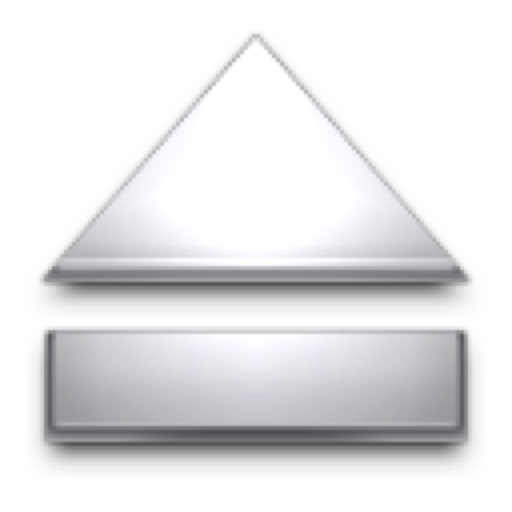
Eject is a little dingus you can keep in your Mac’s Dock. Click it, and it’ll eject all disks except the startup disk, as well as an iPod if iTunes has one connected. It’s just a little AppleScript packaged as an application with a nice ejectish icon. Download this, unzip it, drag it to Applications, and then drag it into your Dock.
I use it to eject external drives (mainly my Time Machine drive) before I pack up my MacBook Pro to take it on the road.
(I could have sworn that I posted this before, but I can’t find it, so… )
Hypercritical #33 correction: <em> and <strong> … not <b> and <i>. Apologies to @gruber and semantic markup sticklers.
(Hypercritical is a podcast he does with Dan Benjamin at 5×5.com; go listen, but there’s nothing in the podcast relevant to what follows here.)
The idea here is that the <b> & <i> tags (bold & italic) are typographical, or display, instructions, and as such should be left up to the page designer. We should supply semantic markup instead to give the designer enough information about what we want displayed that the italic or bold typeface can be chosen as appropriate. For our purposes, those tags are <em> and <strong>, short for “stress emphasis” and “strong importance”. <strong> can be nested to indicate stronger and stronger importance.
This kind of semantic markup is fine in its place, but HTML isn’t the place to enforce it. A sufficient reason is that HTML doesn’t have a rich enough set of tags to do the work. The APA Style Manual lists seven reasons to use italics:
Titles of books, periodicals, and microfilm publications
Genera, species and varieties
Introduction of a new, technical, or key term
Emphasis
A letter, word, or phrase referred to as such
Letters use as statistical symbols or algebraic variables
Anchors of a scale
Sure, “emphasis” is on the list…along with six others that HTML has no tag for. And that’s not an exhaustive list.
One of the WordPress themes I use oddly inverts the representation of em/strong from i/b to b/i. It must have seemed like a good idea to someone at some time, but the only way I could use it on my site was to “fix” the CSS, which fortunately I was in a position to do. The thing is, there’s nothing technically wrong with doing that: “emphasis” is nowhere defined as “italics”.
So (except for cases where you’ve already taken care of things via CSS and classes), if you want italics, go ahead and use <i>. Ditto <b> for bold. And don’t apologize for it.
And now for a slight digression. HTML5 adds a bunch of new “semantic tags”, like <header> and <section>. Notice that “semantics” ends up referring to at least two rather distinct categories. The new HTML5 tags describe document structure, a kind of containerization where the container names aren’t all “div”. But the kind of semantic reference we’re talking about in the above list-of-reasons-to-italicize have nothing to do with document structure; they have to do with the connection between the pieces of the document and the great outside world: movie names, species, name-vs-use.
I mention this as an introduction to an oldish essay by John Allsopp, Semantics in HTML5. It’s the kind of thing that’s just as well to keep in the back of your mind when you start creating The Semantic Web.
Oh, the title. I’m not against semantic markup. Really. Just against using em/strong as fancified ways of saying italic/bold and then calling it “semantic markup”.


 The chimera of myth consisted of the parts of three animals: lion, serpent and goat. By extension, a bio/genetic chimera is an animal composed of more than one genetic line (Wikipedia is there to help if you want to know more).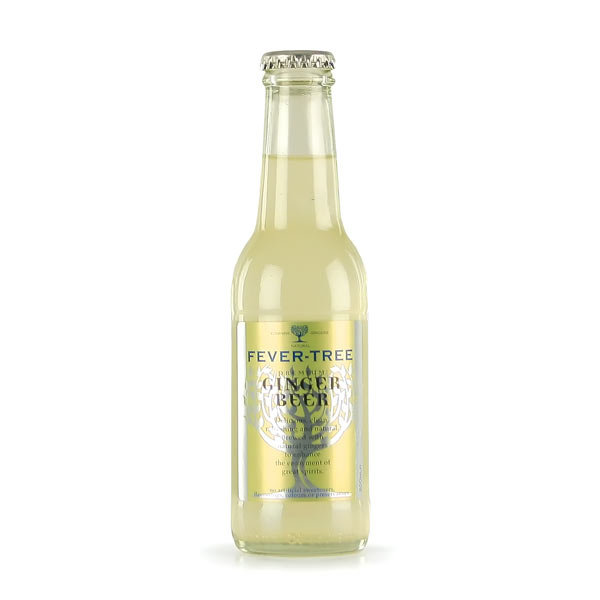
 I subscribe, via rss, to Christopher Lydon’s
  Eject is a little dingus you can keep in your Mac’s Dock. Click it, and it’ll eject all disks except the startup disk, as well as an iPod if iTunes has one connected. It’s just a little AppleScript packaged as an application with a nice ejectish icon. Download